Wednesday, July 28, 2021

Ghost Town: Goldfield, Nevada

Learning about Nevada's history, mining communities throughout Nevada have popped up seemingly overnight after the discovery of ore. Thousands traveled to these community in search of their fortune, only to see many of them die out after the boom came to an end. While the people have left, ghost towns still have a story to tell and one can learn an important part of the Silver State's history. We visited Goldfield, to learn and explore the history and its people.
Goldfield, was one of the great boomtowns of the early 1900s. Gold was discovered in 1902. Within four years, it had 30,000 residents. From 1906 to 1910 Goldfield was the largest city in Nevada. Total production in 1901 was over $3 million dollars, at about $12.40 a troy ounce silver. From 1901 thru 1940 Goldfield recorded production over $90,000,000, mainly in gold. In today's prices, that's about $1.8 billion dollars.
But the town was hit by fires (1905 and in 1906) destroyed several businesses and a flash flood (1913). In 1923 a fire leveled 54 square blocks. The gold dried up. And by 1923, the population was under 1000. Today, Goldfield is a near ghost town with under 270 residents - but many architectural reminders of the good old days.
The Goldfield Hotel


Nan in front of the building
The Goldfield Hotel: Opened in 1908 is four stories of stone and brick. The structure cost over $300,000. The original plans called for 150 rooms and 45 suites with private baths. Each room had a telephone, and the building was heated by steam. The lobby had luxurious mahogany paneling and leather banquettes. The hotel is one of the largest and most notable "ghost buildings" in the West.
"Tex" Rickard House
Another Goldfield landmark is the "Tex" Rickard House. To promote Goldfield, he and others staged a prize fight on Labor Day, 1906. Joe Gans and Battling Nelson fought for the Lightweight Championship of the world. In the 42nd round Nelson was disqualified, and Joe Gans was declared the winner of the $30,000 purse.

Saloon

Santa Fe Motel
The Santa Fe Saloon (1905) is one of Goldfield's oldest continuously-operating businesses. Today, the Santa Fe, with its eight motel rooms, is still a popular oasis.
The Mozart Tavern (formerly the Hoist House) is located at the corner of Crook/Hwy 95 and North Columbia. The building boasts an authentic atmosphere and is a favorite for locals as well as tourists.
Courthouse
Esmeralda County Courthouse built in 1907, when the county seat transferred to Goldfield from Hawthorne, NV, it is still the County seat today.
Goldfield Fire Station #1 built in 1907, served as the town's fire house until June 2002.
Goldfield High School built in 1907. The 3-story structure was designed by J.B. Randall. It has a floor area of over 19,656 square feet. The interior has 12 classrooms, an auditorium, 2 offices, 2 bathrooms, 4 storage rooms, and extra-large attic and a seating capacity of 450. The first year's enrollment was 125 students and about 25 faculty members. When we visited, it was close due to their efforts in restoring the Goldfield High School.

Some of the more famous visitors and residents of Goldfield included Virgil and Wyatt Earp, George Wingfield, Death Valley Scotty, Jack Dempsy, and Governor and late U. S. Senator Tasker Oddie. 
Virgil Earp

Allie Packingham Sullivan Earp
Virgil Earp and his wife Allie (Alvira) arrived in Goldfield. Shortly after his arrival, Virgil was sworn in as a deputy sheriff of Esmeralda County, and served right up to his death on October 19, 1905. He died of pneumonia in the Saint Mary's County Hospital on Euclid Ave, Goldfield, while holding his wife's hand as he laid in bed. They were together for thirty-two years.

Our visit gave us a sense of what it was like to live in gold rush boomtown in early 20th century. Great fun exploring and investigating around the town. Of course, great photography as well.

Here are few more photos:


Thanks for reading, safe travels!

Tuesday, July 27, 2021

Ghost Town - Gold Point, Nevada

Continuing with our ghost town visits, we explored Gold Point, Nevada. 
Town Sign
Originally a silver mining camp in the early 1860s and founded as Lime Point, Gold Point was once quite the happening boomtown that consisted of 125 dwellings, a post office, bakery, hotels, cafes, a store and numerous saloons. Silver was the strike that brought people here first. There was so much silver all you had to do was shovel it right up off the ground. This type of super-gene enrichment was known as hornsilver.


The first thing we saw as we drove up to the town was a truck that looks like Maynard from the Pixar movie, Cars. Mostly faded green, a hook and crane in the back, the worn tires ragged and flat.

Walking around the town brought a feeling of stepping back in time to the lawless days of claim jumpers and cattle rustlers.
Nan walking in the middle of the street.

As we pass by the saloon there was the faint echo of an old-time western music from inside but as I circled the building, there were no other signs of life. It does not seem completely abandoned if you look at 27 mail boxes, but on the day, we visited we saw no one.
Saloon


Miners continued to eke out a living until 1927, then the town experienced a new boom. Gold was discovered in Hornsilver's biggest mine.
County of Esmeralda Fire Truck.

House of Rude - Information & Tickets

The Gallows. Oh, and a bathtub.

The residents changed the name of the town to Gold Point in 1932. Times were hard in those depression years and the residents changed the name in a desperate attempt to attract investors. Mining continued until World War II when the government banned all mining except for those minerals needed for the war effort. After the war, some folks drafted back, but the town was completely abandoned in the 1960s after a bad dynamite charge caused a disastrous cave-in.
Samuel Clemens (Mark Twain) wrote about his time as a miner in the Esmeralda District in his book "Roughing it."

The buildings lay deserted for a decade until a man named Herb Robbins and a few of his friends began to purchase the buildings, one by one, in the 1970s. He and his friends continued to repair roofs and lovingly refurbish interiors.

Some of the cabins are now part of a bed and breakfast. Profits from the B&B help to pay for the restoration and preservation of many of the buildings.
Cabins

Gold Point was named Hornsilver until the 1930s.

The Gold Point Ghost Town, B&B website says, "When you visit Gold Point you may not see anyone, but rest assured they are watching you." Sounds kind of creepy, but basically, it's just a neighborhood watch program. Today, they boast a population of 6 full residents and 6 part time residents. Neighbors looking out for each others are why Gold Point is so well preserved and safe.
Mines at Gold Point, NV

I think the town's apparent abandonment is part of the charm in visiting. We took many photos and left only our footprints.

Gaffers & Sattler


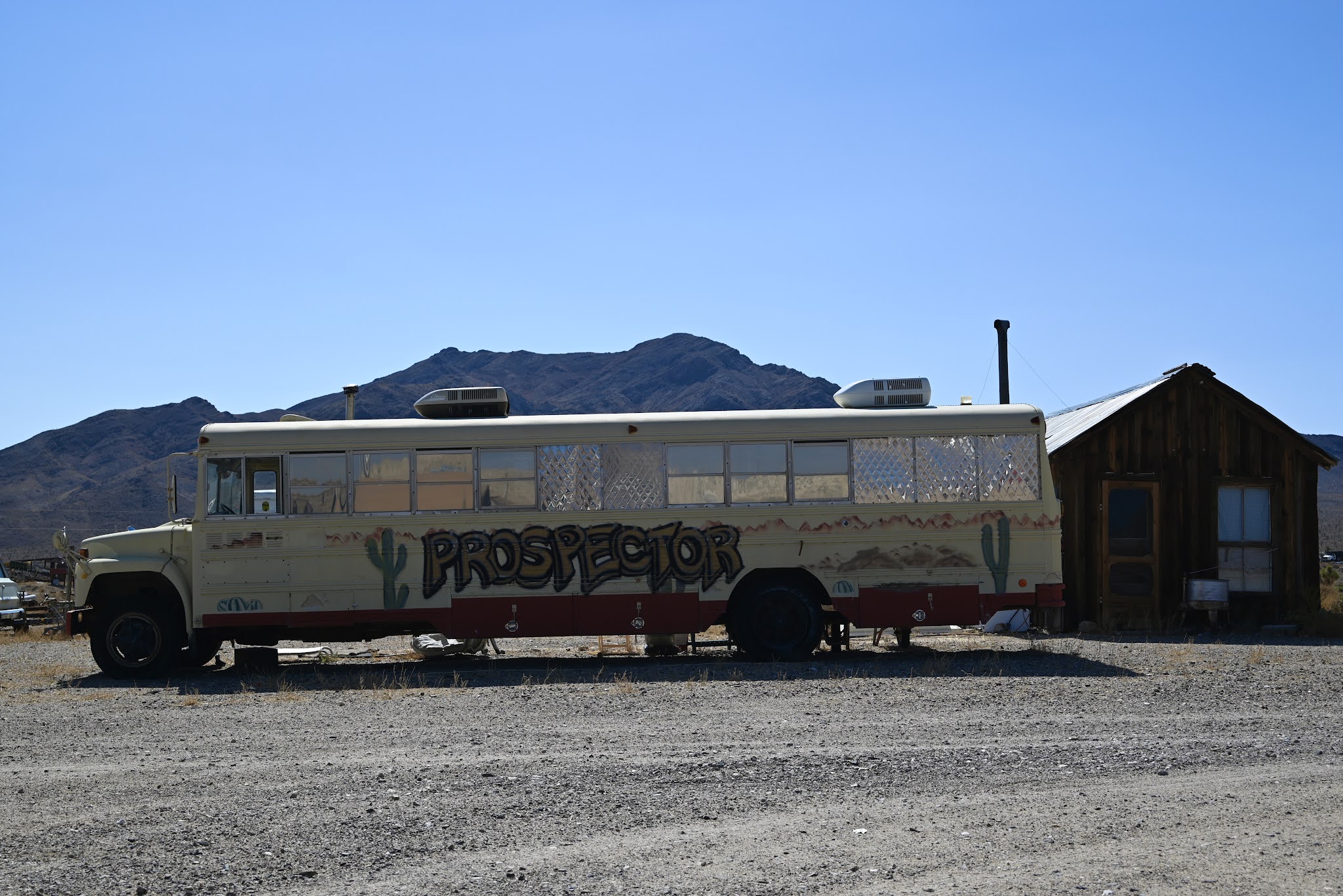
Prospector

Ol' Yeller

Gold Point is north of Beatty, about 7 miles off Highway 95 on Highway 266.

We hope you enjoy visiting a ghost town heritage with us. Safe travels!

Ghost Town - Bonnie Claire, Nevada

As we travel to Tonopah, NV, we stopped at Bonnie Claire, NV. It is a ghost town located in Nye Country just off US-95 N to NV-267 W. Driving toward the town, we spotted the mill ruins up on the side of a long hill. We stopped at the mill ruins first to explore.

Sign "Private Property."

Unfortunately, we wouldn't able to get close to investigate due to a sign posted "Private Property, No Trespassing," so I took these photos using my zoom lens.

The Mill

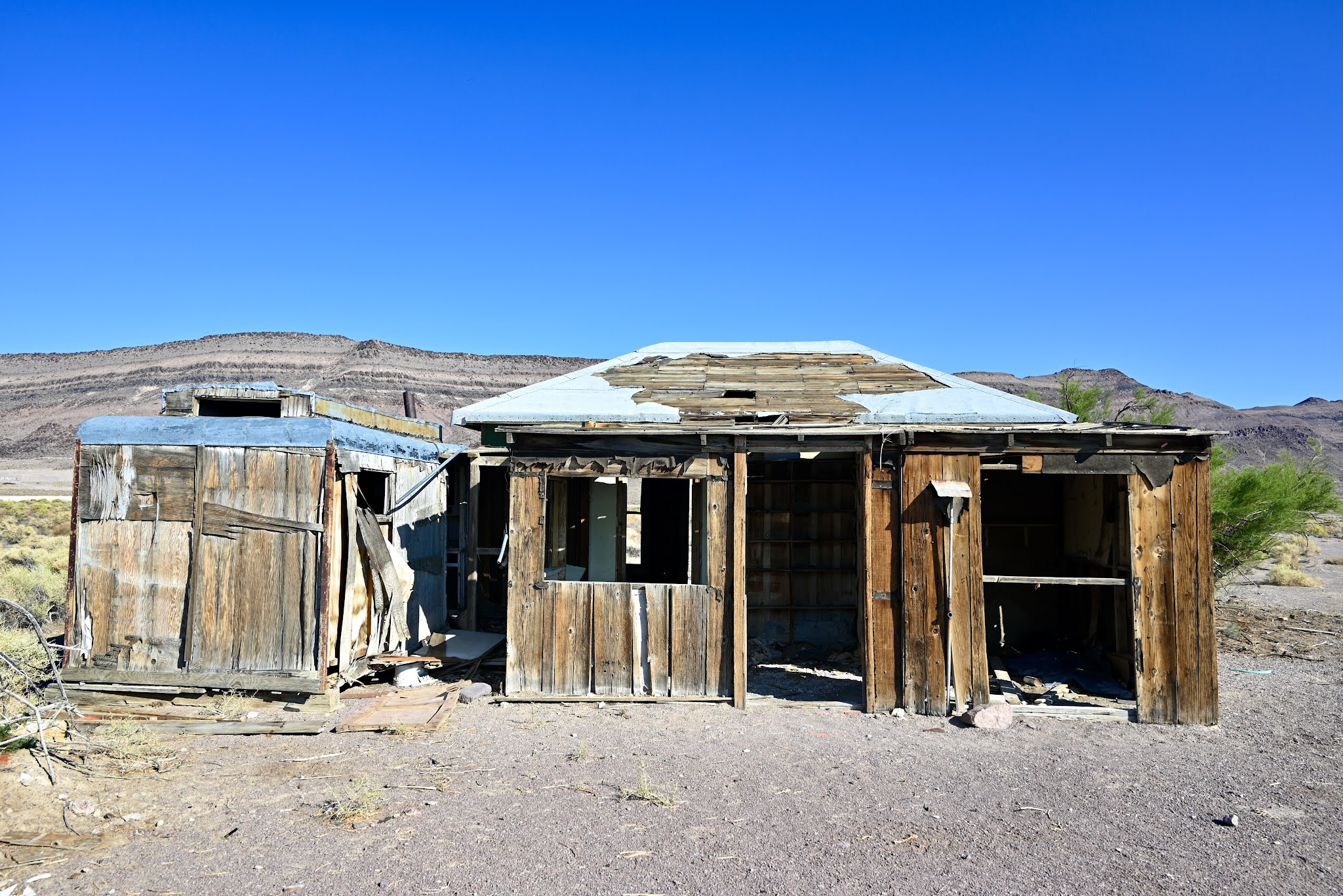
This ruin was once a bunkhouse for workers at the Mill

After taking few photos, we head over to the other side of the road, to explore the little complex of buildings.

Mill? Processing Plant? Not sure, but it looks like it was used to pull ore up from the shaft.

The ruins of a home built in the mid-1950s.

Living Room?

Bedroom

Kitchen?

A vintage trailer added to the side of the home, maybe for extra living space.

Bonnie Claire sprang up in 1904 and there were some minor activities during the period from 1940 to 1954 but like many of these old mining towns, Bonnie Claire became a ghost town.

This was about as close as I can get to look down this mine shaft.

Tempted to go down the ladder to explore, but the wisdom told me, "not to."
Open Range.

We saw wild burros as we departed Bonnie Claire

Thanks for reading one of ghost town heritage! Safe travels.

Loneliest Road in America and Beyond

We've heard about the "Loneliest Road in America" that we decided to take a trip on this road. In July of 1986, Life magazine ...